
Why EV-Ready Buildings Need More Than Chargers: The Convergence of EV Charging, Solar, Batteries and Smart Property Infrastructure
By Frank Chang, TerraFuse Market Intelligence Update | June 04, 2026
Why EV-Ready Buildings Need More Than Chargers
Australia’s electrification journey continues to accelerate.
This week, key developments across EV charging, battery energy storage systems (BESS), vehicle-to-grid technology, strata legislation and renewable energy infrastructure reinforced a common theme: property stakeholders can no longer view EV charging as a standalone upgrade.
Instead, EV charging is becoming part of a broader building infrastructure conversation that includes electrical capacity, solar integration, battery storage, smart parking management and future energy resilience.
For strata managers, owners corporations, building managers, facility managers and developers, the challenge is shifting from whether EV charging is needed to how it should be implemented strategically.
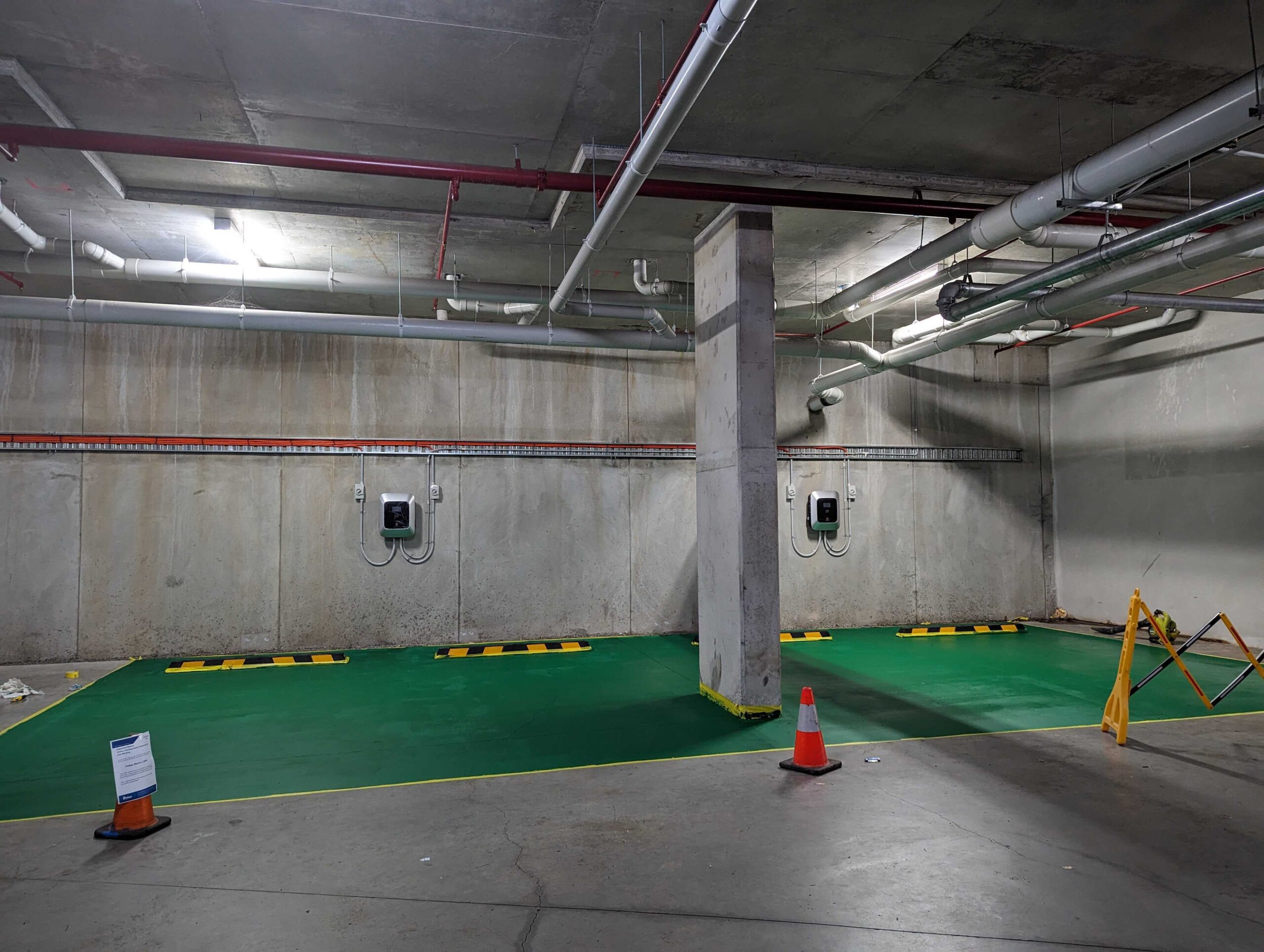
1. NSW Continues to Push EV Readiness in Strata Buildings
NSW remains one of Australia’s most active markets for EV infrastructure adoption within apartment and strata communities.
Recent strata reforms continue to reduce barriers to sustainability infrastructure, including EV charging systems and rooftop solar. NSW government guidance released this year highlights ongoing changes affecting owners corporations and strata committees.
Industry guidance published during recent weeks has also emphasized that EV charging is rapidly becoming a standard consideration for strata committees rather than a niche resident request.
Additional NSW reforms have strengthened the ability of lot owners to pursue EV charging installations while limiting unreasonable objections from owners corporations.
For many apartment buildings, the discussion is no longer about approving one charger. The focus is increasingly turning toward whole-building electrical planning and scalable charging infrastructure.
What this means
Buildings that proactively assess electrical capacity today will be significantly better positioned as EV ownership continues to grow.
2. Charging Infrastructure Is Becoming a Strategic Priority
The NSW Government recently announced a refreshed EV strategy backed by significant investment aimed at accelerating charging deployment and addressing charging access gaps.
One of the key observations from industry stakeholders is that the challenge is often not overall electricity generation but local distribution capacity, particularly in apartment-heavy and high-density urban environments.
This has direct relevance for:
- Apartment buildings
- Mixed-use developments
- Commercial properties
- Visitor parking environments
- Existing strata communities
As EV adoption increases, buildings that were never designed for large-scale vehicle charging may require infrastructure assessments, load management systems and staged deployment plans.
What this means
Property owners should focus on future-proofing infrastructure rather than responding to individual charging requests one at a time.

3. Battery Storage and Vehicle-to-Grid Are Moving Closer to Mainstream Adoption
Battery storage remains one of the fastest-growing segments of the clean energy transition.
At the same time, vehicle-to-grid (V2G) technology is steadily progressing toward commercial deployment. Industry leaders now describe EVs as being increasingly capable of functioning as distributed energy assets that can support homes and potentially the broader electricity grid.
The implications are significant.
An EV may soon be more than a transport asset. It may become part of a building’s energy management ecosystem alongside:
- Rooftop solar
- Battery storage
- Smart load management
- Embedded energy systems
- Demand response programs
What this means
Future-ready buildings should be designed with energy integration in mind rather than treating EV charging, solar and battery systems as separate projects.
4. Queensland’s Renewable Energy Pipeline Continues to Grow
Queensland continues to demonstrate strong momentum across solar and battery infrastructure.
Large-scale renewable projects combining solar generation and battery storage illustrate the direction of Australia’s energy transition. Hybrid energy systems are increasingly becoming the preferred model for delivering reliability, flexibility and grid support.
For commercial property owners and developers, this trend reinforces the value of considering on-site energy generation, storage and EV charging infrastructure as part of a coordinated long-term strategy.
What this means
The strongest property assets are increasingly likely to be those capable of integrating renewable energy, battery storage and electrified transport infrastructure.
5. Visitor Parking and Smart Access Management Are Becoming More Important
One of the most overlooked aspects of EV readiness is parking management.
As charging infrastructure expands, property stakeholders must also consider:
- Visitor charging access
- Shared charging allocation
- Billing and cost recovery
- Resident access management
- Usage monitoring
- Future scalability
The challenge is no longer purely electrical.
It is operational.
Buildings that implement charging infrastructure without clear parking management strategies may face congestion, resident disputes and inefficient utilisation.
What this means
EV charging and visitor parking technology should increasingly be evaluated together rather than as separate systems.
6. The Strategic Opportunity for Property Stakeholders
The strongest signal emerging this week is convergence.
Historically, many building upgrades were treated as separate projects:
- EV charging
- Solar systems
- Battery storage
- Parking technology
- Energy monitoring
Today, these systems are becoming interconnected.
Forward-thinking property owners are beginning to view electrification as a building-wide infrastructure strategy rather than a collection of individual upgrades.
The result can include:
- Improved resident satisfaction
- Increased asset attractiveness
- Better long-term capital planning
- Reduced future retrofit costs
- Stronger sustainability outcomes
Conclusion
Australia’s EV transition is accelerating, supported by policy reform, charging infrastructure investment, battery innovation and growing market adoption.
For strata communities, building managers, facility managers and developers, the key lesson is clear:
EV readiness is no longer just about installing chargers.
The most resilient buildings will be those that integrate EV charging, solar, battery storage, smart parking and energy management into a coordinated long-term infrastructure plan.
Those who begin planning today will be better positioned for tomorrow’s electrified property landscape.
TerraFuse Perspective
TerraFuse recommends that property stakeholders undertake a professional site assessment before EV demand becomes urgent.
A building-wide assessment can help identify:
- Electrical capacity constraints
- EV charging opportunities
- Visitor parking requirements
- Future solar and battery integration potential
- Staged deployment pathways
This approach reduces future costs while improving long-term building readiness
References
- NSW Government – Guide to strata law changes for strata committees and owners. (NSW Government)
- Renew Economy – NSW removes strata blocking vote on EV chargers and rooftop solar. (Renew Economy)
- TSM Strata – EV Charging for Strata Buildings: A Committee Guide for 2026. (TSM)
- PICA Group – NSW State Legislation Updates. (PICA Group)
- EVSE Australia – EV Charging for Strata and Multi-Tenancy Buildings. (EVSE Australia)
- NSW EV Strategy announcements and charging infrastructure investment updates. (The Australian)
- Polestar Australia – Vehicle-to-Grid developments. (The Australian)